Uncertainty, Vagueness, and Ambiguity in Human-Robot Interaction: Why Conceptualization Matters
2nd Interactive AI for Human-Centered Robotics Workshop at the ACM/IEEE International Conference on Human-Robot Interaction (HRI),
doi: 10.48550/arXiv.2604.15339
- Mar 2026
Associated documents :


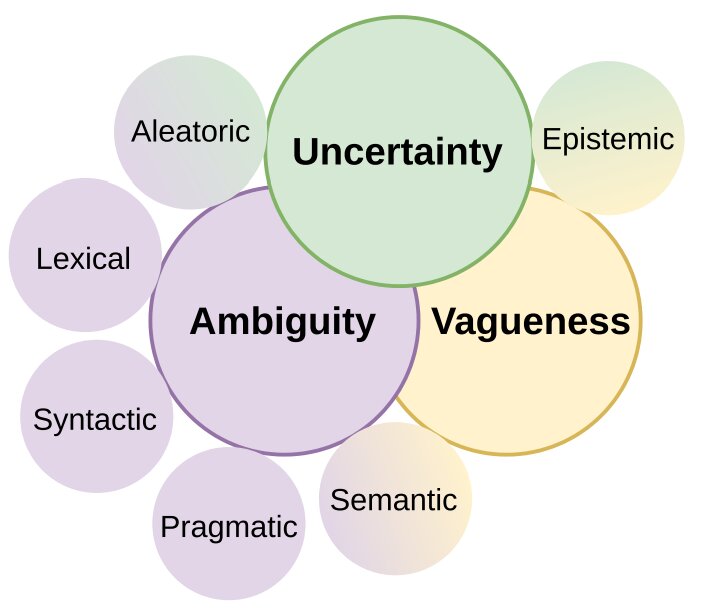
Uncertainty, vagueness, and ambiguity are closely related and often confused concepts in human-robot interaction (HRI). In earlier studies, these concepts have been defined in contradictory ways and described using inconsistent terminology. This conceptual confusion and lack of terminological consistency undermine empirical comparability, thereby slowing the accumulation of theory. Consequently, consistent concepts that clarify these challenges, including their definitions, distinctions, and interrelationships, are needed in HRI. To address this lack of clarity, this paper proposes a consistent conceptual foundation for the challenges of uncertainty, vagueness, and ambiguity in HRI. First, we examine the meanings of these three terms in dictionaries. We then analyze the nature of their distinctions and interrelationships within the context of HRI. We further illustrate these characteristics through examples. Finally, we demonstrate how this consistent conceptual foundation facilitates the design of novel methods and the evaluation of existing methodologies for these phenomena.
@InProceedings{SWKSW26,
 	 author =  {Sun, Xiaowen and Weber, Cornelius and Kerzel, Matthias and Spisak, Josua and Wermter, Stefan},
 	 title = {Uncertainty, Vagueness, and Ambiguity in Human-Robot Interaction: Why Conceptualization Matters},
 	 booktitle = {2nd Interactive AI for Human-Centered Robotics Workshop at the ACM/IEEE International Conference on Human-Robot Interaction (HRI)},
 	 journal = {}
 	 editors = {}
 	 number = {}
 	 volume = {}
 	 pages = {}
 	 year = {2026},
 	 month = {Mar},
 	 publisher = {}
 	 doi = {10.48550/arXiv.2604.15339},
 	 url = {}
 }