Robot in a crib: How a playing robot helps us understand sensorimotor contingency learning
Science Robotics,
Volume 11,
Number 117,
pages eaed4106,
doi: 10.1126/scirobotics.aed4106
- Aug 2026
Associated documents :


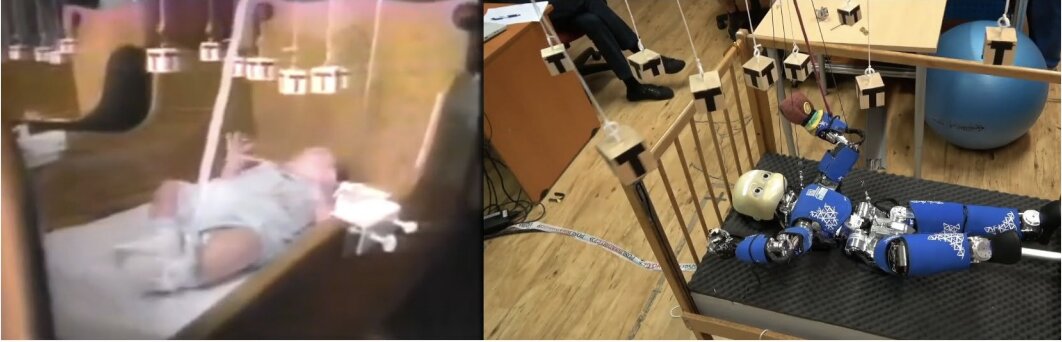
Learning sensorimotor contingencies - that is, the link between one's actions and their sensory effects - is fundamental to developing body knowledge, understanding causality, and developing a sense of agency. In developmental psychology, this process is classically studied using the mobile paradigm, where infants learn that movement of a limb causes motion of a connected mobile. To expand our understanding of how infants learn this, we tested an embodied computational model that learns through two biologically inspired mechanisms: prediction and curiosity. Implemented on the child-sized iCub humanoid robot interacting with a mobile, the model detected sensorimotor contingencies across several experimental conditions using a variety of movement strategies. Our findings suggest that contingency learning cannot be captured by a single behavioral metric, such as the amount of movement, but instead emerges through a spectrum of exploratory behaviors. Analysis of the robot's internal activity reveals that these behaviors emerge from the dynamic trade-off between prediction and curiosity - between exploitation and exploration. Our work provides a biologically motivated, physically embodied model of sensorimotor interaction that connects theories of infant learning with robotic implementations. The results allow us to generate testable hypotheses for developmental research and to inform the design of autonomous learning systems. Experiments with a humanoid robot using prediction and curiosity reveal how infants learn sensorimotor contingencies. https://www.science.org/eprint/KJ3AVYAICKSA5C83NVZR/full?activationRedirect=/doi/full/10.1126/scirobotics.aed4106
@Article{SPRWOH26,
 	 author =  {Spisak, Josua and Popescu, Sergiu Tcaci and Rustler, Lukas and Wermter, Stefan and O'Regan, J. Kevin and Hoffmann, Matej},
 	 title = {Robot in a crib: How a playing robot helps us understand sensorimotor contingency learning},
 	 booktitle = {}
 	 journal = {Science Robotics},
 	 editors = {}
 	 number = {117},
 	 volume = {11},
 	 pages = {eaed4106},
 	 year = {2026},
 	 month = {Aug},
 	 publisher = {}
 	 doi = {10.1126/scirobotics.aed4106},
 	 url = {https://www.science.org/doi/abs/10.1126/scirobotics.aed4106}, {https://www.science.org/eprint/KJ3AVYAICKSA5C83NVZR/full?activationRedirect=/doi/full/10.1126/scirobotics.aed4106},
 }