Explainable lifelong streaming learning based on Episode-to-Concept formation
Knowledge-Based Systems,
Volume 352, Part C,
doi: 10.1016/j.knosys.2026.117075
- Oct 2026
Associated documents :


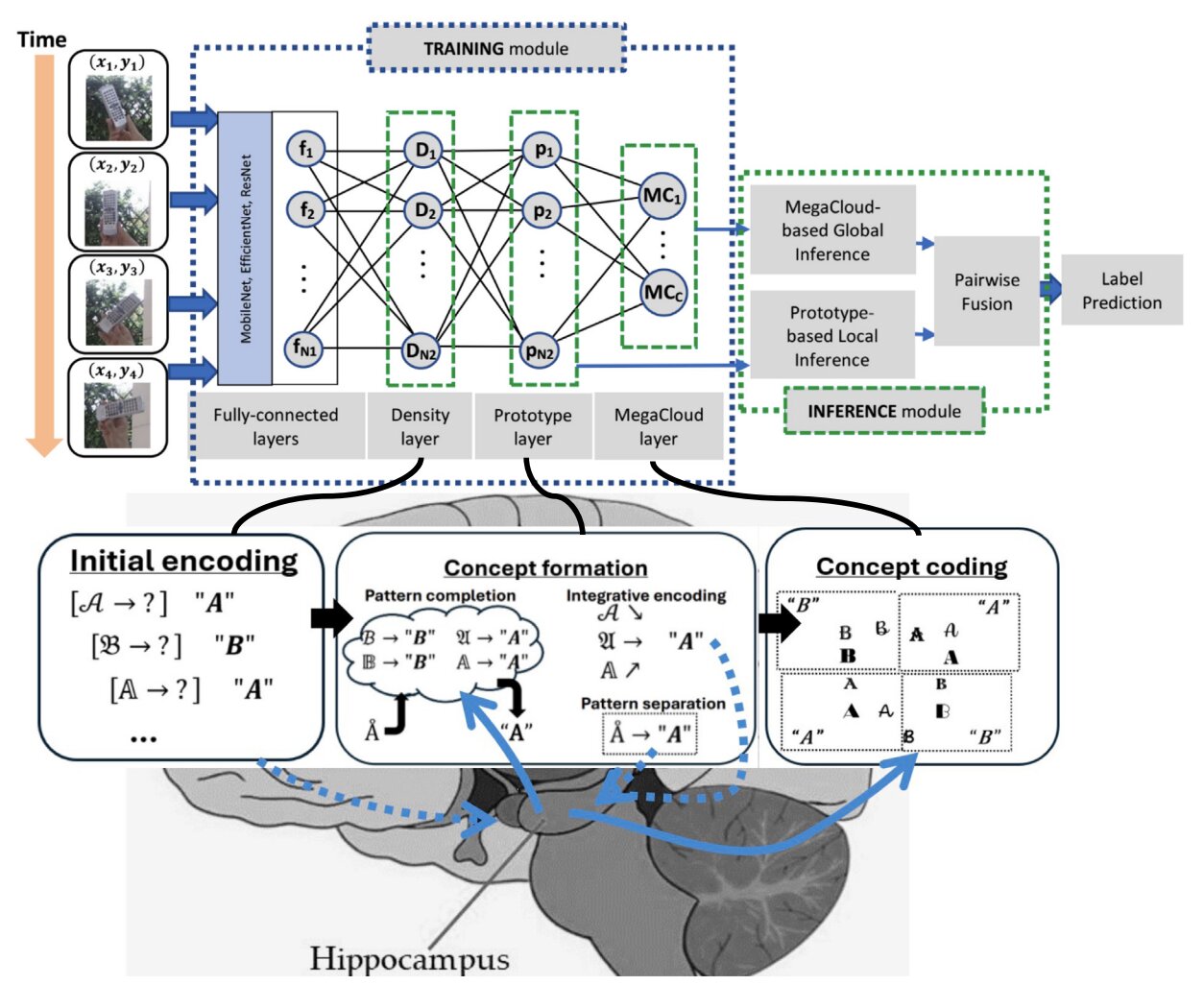
Real-time on-device continuous learning is increasingly used in critical embedded applications, such as medical monitoring, where user trust and transparency are equally as important as accuracy. Current streaming models are often "black boxes," making it difficult to determine how and why a model arrives at a particular decision. To address this, we propose the Explainable Lifelong Learning (ExLL) model, a neuroscience classifier inspired by the Episodic-to-Concept (EpCon) theoretical model of hippocampal function in concept learning. ExLL is capable of: (1) efficient learning from scarce, streaming data in a single pass; (2) a self-organizing prototypebased architecture dynamically expands as needed, clustering the streaming data into separable groups by similarity and preserves data against catastrophic forgetting; (3) an interpretable architecture that can be represented as IF-THEN rules for inference auditing; and (4) combines local prototype inference with global class-level context using a pairwise decision fusion process to maximize performance. While the design of the architecture incurs a higher memory cost compared to simpler centroid-based models, this is a calculated trade-off to provide explainability functionality. We compare ExLL against selected established lightweight streaming algorithms to evaluate the performance in several learning scenarios with the benchmark datasets OpenLORIS, Places365, and F-SIOL-310. Our findings showed that ExLL outperformed baselines such as SLDA and Replay, in classification accuracy across diverse continual learning scenarios, proving that state-of-the-art streaming performance can be successfully balanced with granular, human-readable explainability.
@Article{LCLW26,
 	 author =  {Loo, Chu Kiong and Chen, Yi and Liew, Wei Shiung and Wermter, Stefan},
 	 title = {Explainable lifelong streaming learning based on Episode-to-Concept formation},
 	 booktitle = {}
 	 journal = {Knowledge-Based Systems},
 	 editors = {}
 	 number = {}
 	 volume = {352, Part C},
 	 pages = {}
 	 year = {2026},
 	 month = {Oct},
 	 publisher = {}
 	 doi = {10.1016/j.knosys.2026.117075},
 	 url = {https://www.sciencedirect.com/science/article/pii/S0950705126018010?dgcid=coauthor},
 }